 EduBridger
by Edoxi Training Institute Kuwait
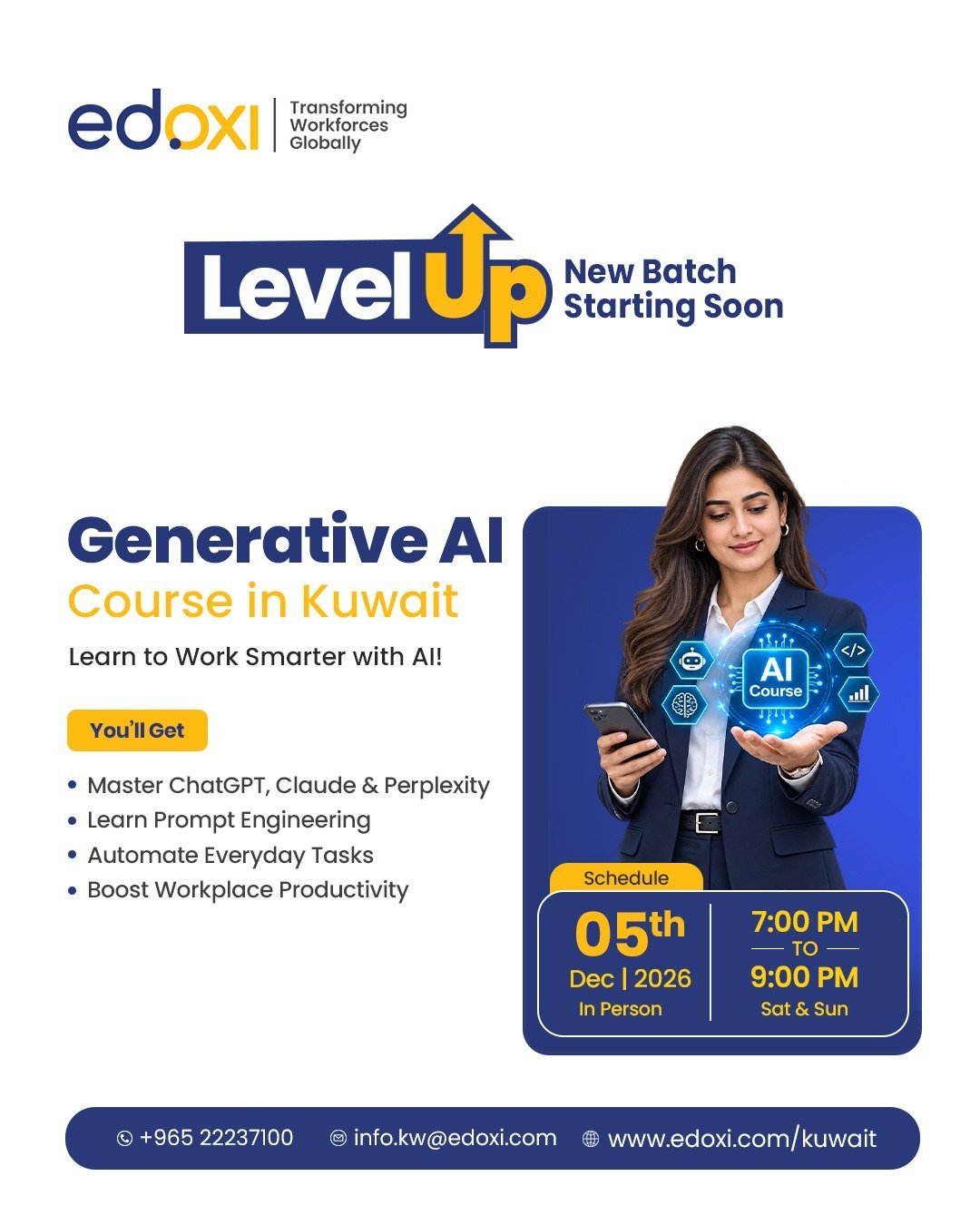
Explore the practical applications of Artificial Intelligence with the Generative AI Training Course in Kuwait offered by Edoxi Training Institute.
This 24-hour instructor-led programme is designed for students, fresh graduates, working professionals, managers, entrepreneurs and corporate teams who want to understand and apply Generative AI in real workplace situations.
The course introduces popular AI platforms such as ChatGPT, Claude, Perplexity and NotebookLM. Participants develop practical skills in prompt engineering, AI-assisted content creation, business research, report generation, workflow optimisation and productivity improvement.
Key Learning Areas:
Generative AI fundamentals and workplace applications
Prompt engineering and structured prompting techniques
ChatGPT, Claude, Perplexity and NotebookLM
AI-powered email, report and presentation creation
Business research and information summarisation
AI-assisted Excel and data tasks
Workflow optimisation and automation concepts
Custom AI assistants and responsible AI practices
Practical workplace exercises and projects
Who Should Attend?
Students, graduates, business owners, HR professionals, finance teams, marketing executives, administrators, IT professionals, managers and anyone interested in developing practical AI skills.
Training Benefits:
Learn how to use Generative AI tools effectively, reduce repetitive tasks, improve professional communication, support business decisions and enhance workplace productivity. No coding background is required.
Certification: AI CERTs-accredited training programme.
Training Provider: Edoxi Training Institute, Kuwait.
Website: https://www.edoxi.com/kuwait/generative-ai-course
Contact: +965 22237100
Email: info.kw@edoxi.com
Module 1: Introduction to Generative AI in Workplaces
Chapter 1.1: Foundations of Generative AI
1. What is Generative AI and how does it differ from traditional AI
2. Large Language Models (LLMs) and Multimodal AI
3. Business Use Cases Across Departments
4. AI Limitations, Risks, Bias and Data Privacy
Module 2: How AI Thinks – Practical Understanding of AI Models
Chapter 2.1: Understanding AI Behaviour
1. Tokens and Context Windows
2. Why AI Generates Incorrect Responses
3. Prompt Sensitivity and Response Variation
4. Trust versus Verification in AI
Module 3: Prompt Engineering for Professionals
Chapter 3.1: Prompting Techniques
1. Basic vs Structured Prompts
2. Role-Based Prompting Techniques
3. Step-by-Step and Iterative Prompting
Chapter 3.2: Output Structuring
1. Formatting Outputs (Tables, Lists, JSON)
2. Reusable Prompt Templates
Module 4: AI Tools and Ecosystem
Chapter 4.1: Core AI Platforms
1. ChatGPT and Claude for Content and Reasoning
2. Perplexity for AI Research
3. NotebookLM for Document Analysis
4. Gamma and SlidesAI for Presentations
Module 5: AI for Daily Work Tasks
Chapter 5.1: Workplace Applications
1. AI-Assisted Email Writing
2. Report Generation and Summarisation
3. Research and Documentation Development
4. SOP Creation Using AI
Module 6: AI Workflow Design and Automation Thinking
Chapter 6.1: Workflow Optimisation
1. Identifying Tasks for AI Support
2. Designing AI-Assisted Workflows
3. Workflow Redesign Strategies
4. Introduction to Automation Concepts
Module 7: Responsible AI Usage in Organisations
Chapter 7.1: Ethical and Secure AI Practices
1. Data Privacy and Sensitive Information
2. AI Hallucination and Risk Mitigation
3. Bias, Misinformation and Transparency
4. Organisational AI Policies and Compliance
Module 8: Capstone Project – Real Workplace Simulation
Chapter 8.1: Applied AI Project
1. Manual Task Execution
2. AI-Assisted Task Execution
3. Comparing Efficiency and Outcomes
Module 9: AI for Content and Social Media
Chapter 9.1: Content Creation with AI
1. LinkedIn Content and Personal Branding
2. Blog and Article Generation
3. Short-Form Video Script Writing
4. Content Repurposing Strategies
Module 10: AI for Data and Excel Work
Chapter 10.1: Data Handling with AI
1. Data Cleaning Support
2. Formula Generation and Insights
3. Data Summarisation and Reporting
Module 11: Building Simple AI Automations
Chapter 11.1: Automation Fundamentals
1. Introduction to Automation Tools
2. Basic Workflow Automation Concepts
3. API Concepts (Non-Technical Overview)
4. Internal Task Automation Examples
Practical Exercises and Capstone
- Exercise 1: Identify AI Opportunities
- Exercise 2: Build Better Prompts
- Exercise 3: Create Professional Content with AI
- Exercise 4: Redesign Workflows with AI
- Exercise 5: Build a Custom GPT
- Capstone: Manual vs AI-Assisted Task
We'll contact you soon.
Send us your question and we'll reply by email within one working day.
Our team will reply by email within one working day.